 ResumeFactory.ai
Archived
ResumeFactory.ai
Archived
ResumeFactory.ai
Archived
ResumeFactory.ai
Archived
That is the promise. Underneath it is a careful piece of engineering: the model never invents experience, and a person approves every change before it reaches the document.

You upload a master resume and paste a job description. The product scores one against the other, asks you about the gaps it finds, proposes specific edits, and generates an ATS-readable PDF once you approve them.
The video is hosted on YouTube and only loads when you press play, so this page makes no third-party request until you ask it to.
The model proposes.
The person decides.
Nothing reaches the finished document without someone approving it first.
Three steps on the surface, a scoring and review loop underneath.
The PDF becomes a typed, versioned JSON document that serves as the source of truth for everything that follows. Your experience stays the evidence base.
The product analyzes the posting, maps the skills and qualifications it calls for, and scores your resume against a reference profile across hard skills, experience, education, and projects, with reasoning for each area.
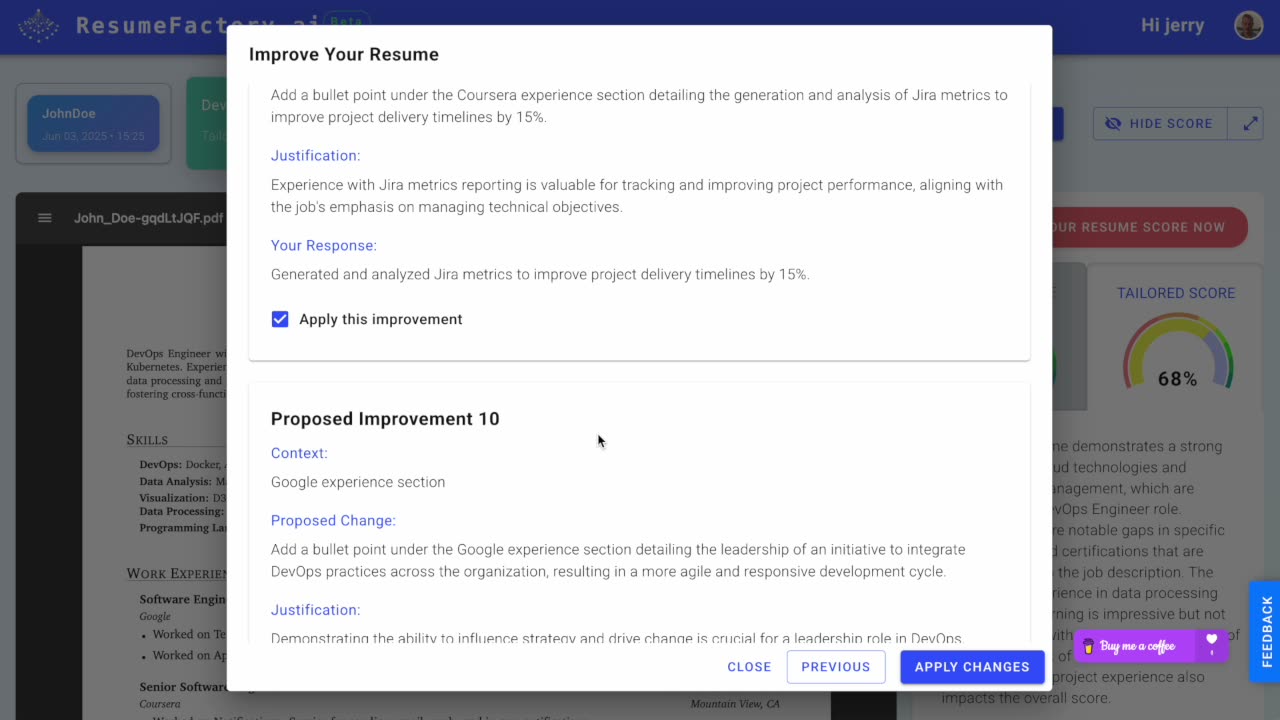
Where it finds a gap it asks you a question rather than filling the gap itself. You approve or reject each proposed change, compare versions, rescore, and export a LaTeX-set PDF.
When the system finds a gap between your history and the role, it generates a structured question for you to answer. It does not write a more impressive candidate into existence.
Rather than one unexplained match number, results break into areas with the reasoning behind each, so you can see which part of the assessment you disagree with.
Approved content flows into a LaTeX template based on the Jake's Resume layout. We imported the generated PDFs into real job sites and checked that fields and sections came out clean.
Recruiters say tailoring your resume for each job helps you stand out. Everyone would do it if it weren't so time-consuming. ResumeFactory.ai imports your existing resume and produces professional, ATS-friendly resumes tailored to a specific job description, whether you want extra polish for one position or a faster path through many.
That is the mission. A resume that an ATS cannot parse gets rejected for the wrong reasons. We tested the output by importing the generated PDFs into several job sites and checking that the fields and sections were extracted cleanly. That practical testing is why the documents are described as ATS-readable.
Yes, and that is the point. After the upload and the job description, a tailored resume is drafted: a customized summary and skills section, with education and experience tuned for the role. You review and refine each suggested change. The result is scored against a reference profile for the position so you can refine it further, then previewed and saved as a PDF.
One: Jake's Resume, a widely used LaTeX layout chosen because it parses cleanly. More templates were planned and never shipped.
The public service closed in January 2026 and no longer accepts uploads or accounts. This archive page runs no analytics, sets no cookies, and collects nothing.
Hundreds of people used it, and it did what it claimed: a structured, grounded workflow rather than a one-shot writing demo. What did not work was the donation-funded business model. Voluntary revenue never covered inference, infrastructure, and continued development, so the public service closed in January 2026 rather than run on subsidy indefinitely.
The product proved the technical thesis. It did not establish a sustainable way to pay for the service.